_PNG.png)

The Return of Balenciaga’s City Bag
If you don’t know it, you definitely recognise it: the Balenciaga City Bag.
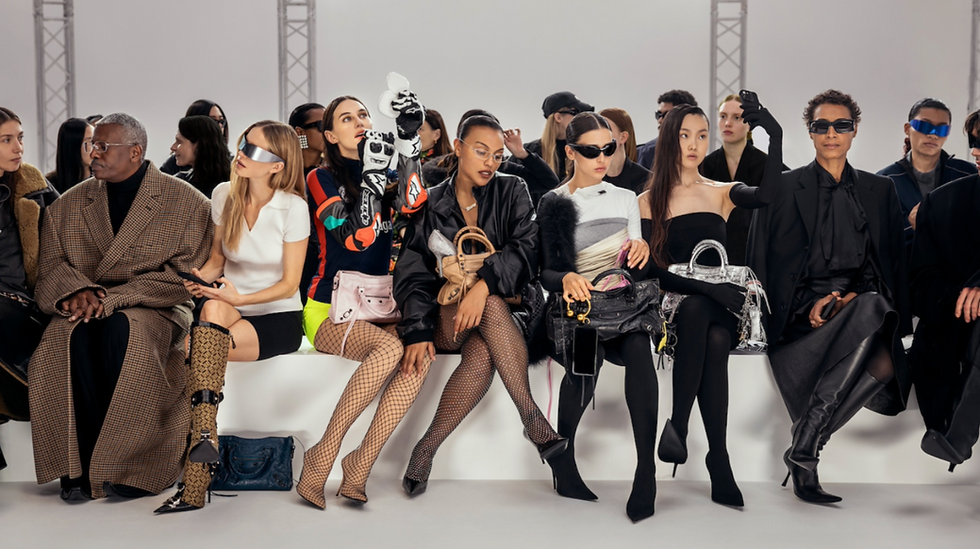
The very first iteration of the City bag came out in 2001, originally launching as the 'Motorcycle Lariat', and was only available in black or brown. The creative director at the time, Nicolas Ghesquière, had been inspired to create a bag recognisable for its slouchy and distressed style alongside chunky metal hardware. However, when the designs were first created, the house’s stakeholders were sceptical about how the public would react to the bag. During a time when structured bags, such as the Louis Vuitton Speedy, were in fashion, the City bag seemed to go against everything in fashion at the time.


At first, only 25 bags were put into production, but soon after, the bag attracted attention all across mainstream media through its appearance in paparazzi photos of Paris Hilton, the Olsen twins and most notably, Kate Moss. The bag had first caught the attention of Moss from the runway, leading her to request the bag immediately. The popularity of the bag skyrocketed as it became synonymous with supermodels’ street fashion, gaining popularity through organic visibility within editorial content.

In 2003, the bag was officially renamed ‘The City’, and the collection expanded with iterations following, such as ‘The First’, ‘The Work, ‘The Velo’, and ‘The Twiggy’. However, as fashion developed, minimalism became the new hype, and the bag slowly became less of a focus for Balenciaga. Between 2014 and 2019, the bag was no longer actively marketed or seen in runway shows, reaching an ‘archival status’. Things were seeming to die down…
In 2020, Y2K fashion was being slowly revived and, naturally, so was the popularity of the Balenciaga City Bag. Circulating all over social media, people started to scour second-hand sellers to obtain the 2000s classic. Trying to appease people’s appetite for the bag, in 2021, Balenciaga released the ‘Le Cagole’, which featured a similar hardware design, designed as an ode to the noughties original.

By 2024, the ‘Le City’ Bag was officially re-released. Only slight adjustments were made to the original to modernise production, with signature details such as its braided top-handles and metal hardware preserved. The bag is available in four sizes (mini, small, medium and large), alongside the Le City ‘First’ and the most recently released ‘East-West’ bag. Balenciaga has since been named the number one luxury brand with a revenue of $106.8 million in 2025, with the 'Le City' listed as one of the main driving factors of this success. The searches for the Balenciaga City Bag have increased by 141.6% each year on FASHIONPHILE. On Vestiaire Collective, a designer resale site, the bag has consistently remained in the top 10 most-wanted bags of the year.
It seems that the popularity of the ‘Le City’ has continued to increase for many reasons. But perhaps one of the biggest reasons can be whittled down to nostalgia. In a time where many noughties trends are re-emerging in the current fashion world, it seems no surprise that people are attracted to a bag which represents both the past and the present.

This is most apparent in Balenciaga’s January 2025 campaign, which featured archival paparazzi images of icons such as Tyra Banks, Paris Hilton and Claudia Schiffer. Balenciaga took advantage of 2000s paparazzi nostalgia to create stock style watermarked images to mimic tabloid photography. Nostalgia, which gives people a sense of stability and comfort, has been used to push contemporary consumption. For the designers on the other side of things, they too are given a blanket of stability with a return to something they know has already worked. But the question is, are we simply paying homage to something iconic, or being trapped in "a convoluted fashion cycle"?
Sources:


Comments